What π really means
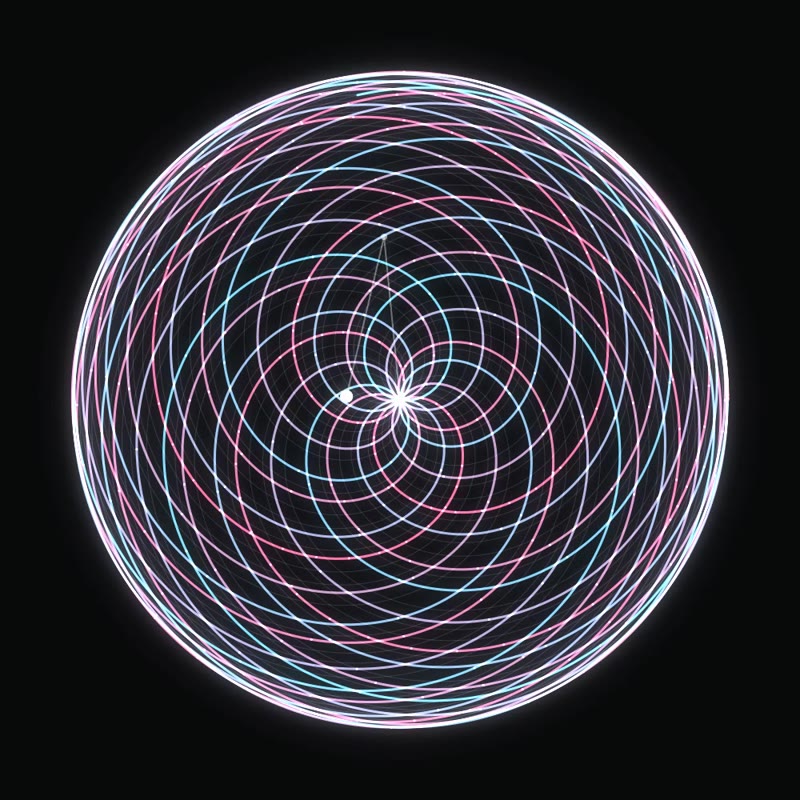
Two arms spin, the outer one π times faster. The curve almost closes, again and again, but never does.
z(θ) = e^(iθ) + e^(iπθ)Two arrows are joined end to end. The first turns once around the centre; the second, attached to its tip, turns π times as fast. The tip of the second arrow leaves the glowing trail.
When a curve closes
If the second arrow turned exactly 3 times as fast, the trail would close after one turn and repeat forever. Any whole-number ratio, or any fraction p/q, closes after q turns: the two arrows are back where they started at the same moment.
π is not a fraction, so that moment never comes.
Near misses
π is very close to some fractions, and the curve shows each one:
| Fraction | Value | What you see |
|---|---|---|
| 22/7 | 3.142857… | after 7 turns the curve almost meets its start |
| 355/113 | 3.1415929… | after 113 turns it almost meets it again, even closer |
The real value, 3.14159265…, always sits a little away from both. Each near miss leaves a thin gap, and the curve keeps going.
Where it ends up
Because the ratio is irrational, the trail never repeats. Run it long enough and it passes arbitrarily close to every point of the disc it lives in, filling it like a spirograph that never finishes.
Swap π for 3 and the drawing closes after a single turn. The whole picture is a portrait of the fact that π is irrational.