What φ really means
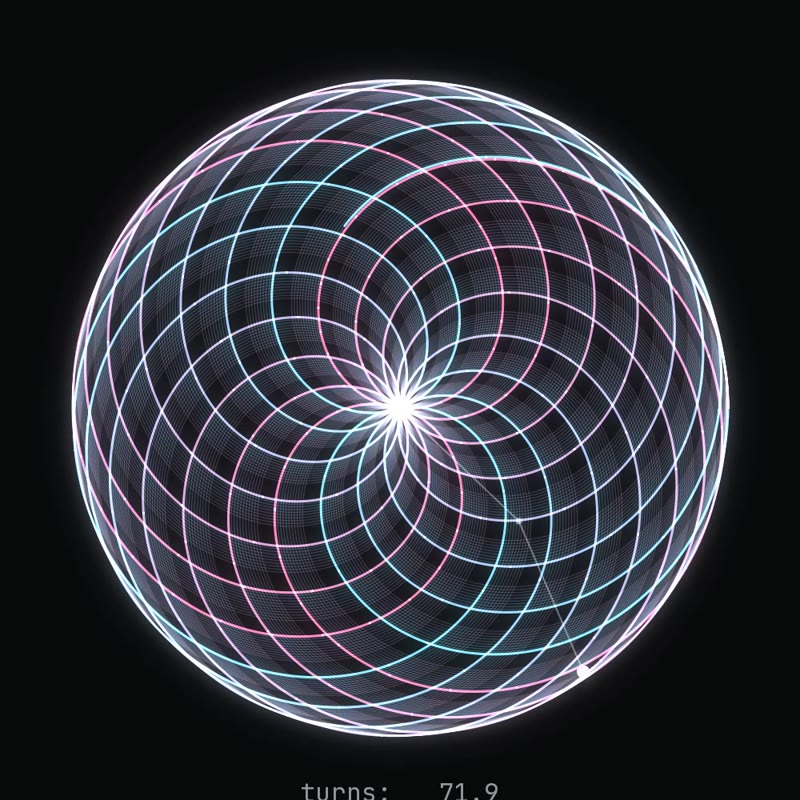
Spin at the golden ratio and the curve never even comes close to closing.
z(θ) = e^(iθ) + e^(iφθ)Two arrows spin end to end, the second one φ = 1.618… times as fast as the first. φ is the golden ratio, (1 + √5) / 2.
In "What π really means" the same setup almost closed after 7 turns, because π is close to 22/7. With φ, the curve never gets close.
The best fractions miss badly
The best fractions for φ are ratios of Fibonacci numbers, and the video stops at each one:
| Turns | Fraction | Miss |
|---|---|---|
| 3 | 5/3 | 0.15 of a turn |
| 8 | 8/5 | 0.06 of a turn |
| 21 | 21/13 | 0.02 of a turn |
| 89 | 144/89 | 0.005 of a turn |
The misses shrink, but slowly. For π, a fraction with a denominator of only 113 is already off by less than a millionth.
The most irrational number
Every irrational number can be written as a continued fraction. φ is the one made only of 1s: 1 + 1/(1 + 1/(1 + …)). That makes its fractions improve as slowly as possible, so φ is the hardest number to approximate. Mathematicians call it the most irrational number.
Plants use it: a sunflower places each new seed 360°/φ² ≈ 137.5° around from the last, so seeds never line up into gaps.