Every times table from ×2 to ×100
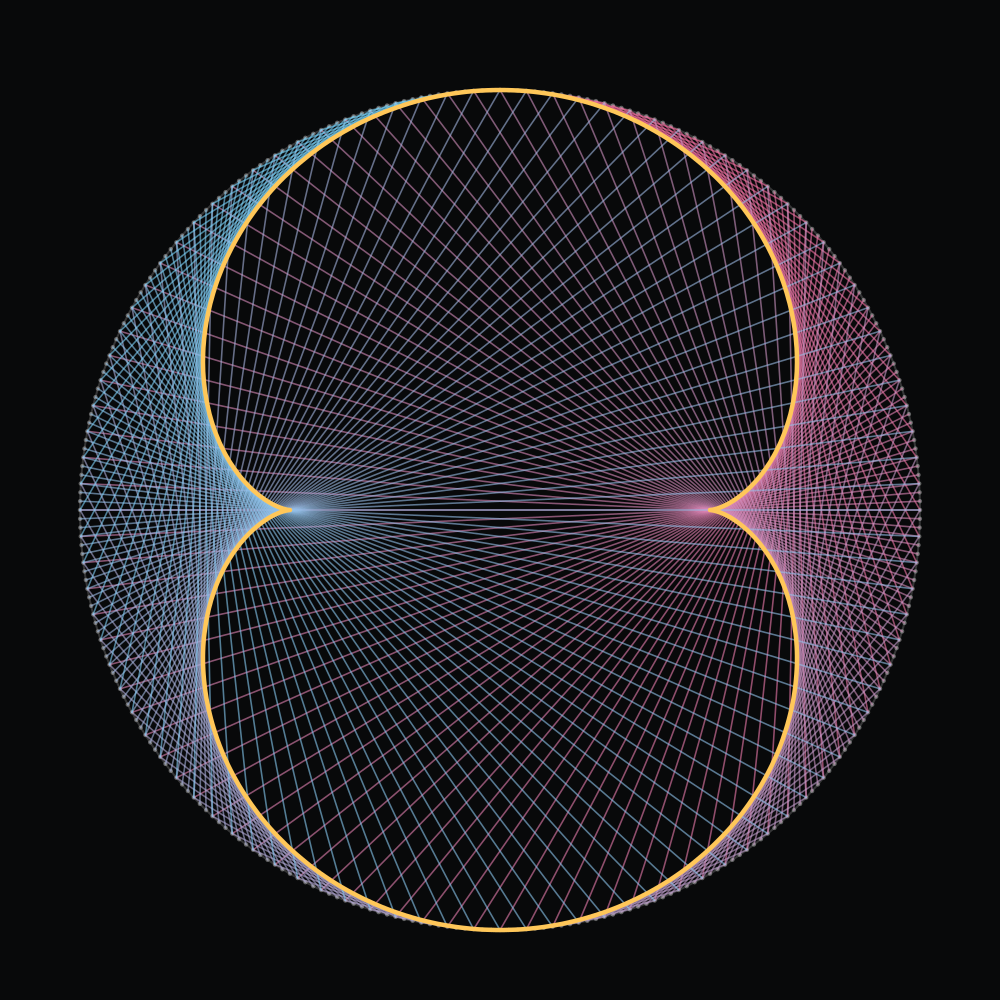
360 points on a circle, and point i joins point m·i.
i → m·i (mod 360)Put 360 points around a circle and number them 0 to 359. Pick a multiplier m. Now draw a straight line from every point i to the point m·i, counting around the circle and wrapping past 359 back to 0.
×2 draws a cardioid
With m = 2, point 1 joins point 2, point 2 joins point 4, point 100 joins point 200. No single line is curved, but together they outline a heart-like curve called a cardioid. Each line touches the curve at exactly one point, so the curve appears as the edge where the lines crowd together.
The same cardioid appears when one coin rolls around another coin of the same size: a point on the rolling coin's rim traces it.
Every multiplier adds a cusp
| Multiplier | Curve | Cusps |
|---|---|---|
| ×2 | cardioid | 1 |
| ×3 | nephroid | 2 |
| ×4 | epicycloid | 3 |
| ×m | epicycloid | m − 1 |
The pattern holds because the line from angle θ to angle mθ is always tangent to an epicycloid with m − 1 cusps: the curve traced by a small circle rolling around the big one.
Between the whole numbers
The video does not jump from ×2 to ×3. It slides through every value in between, so a cardioid slowly folds into a nephroid, then into a shape with three cusps, and so on up to ×100. At high multipliers the lines are so dense that the picture turns into a fine mesh, and new patterns flicker in whenever m lands near a whole number.
Try it on paper with 10 points and ×2. You will already see the cardioid's shape.