5,000 rays in a heart
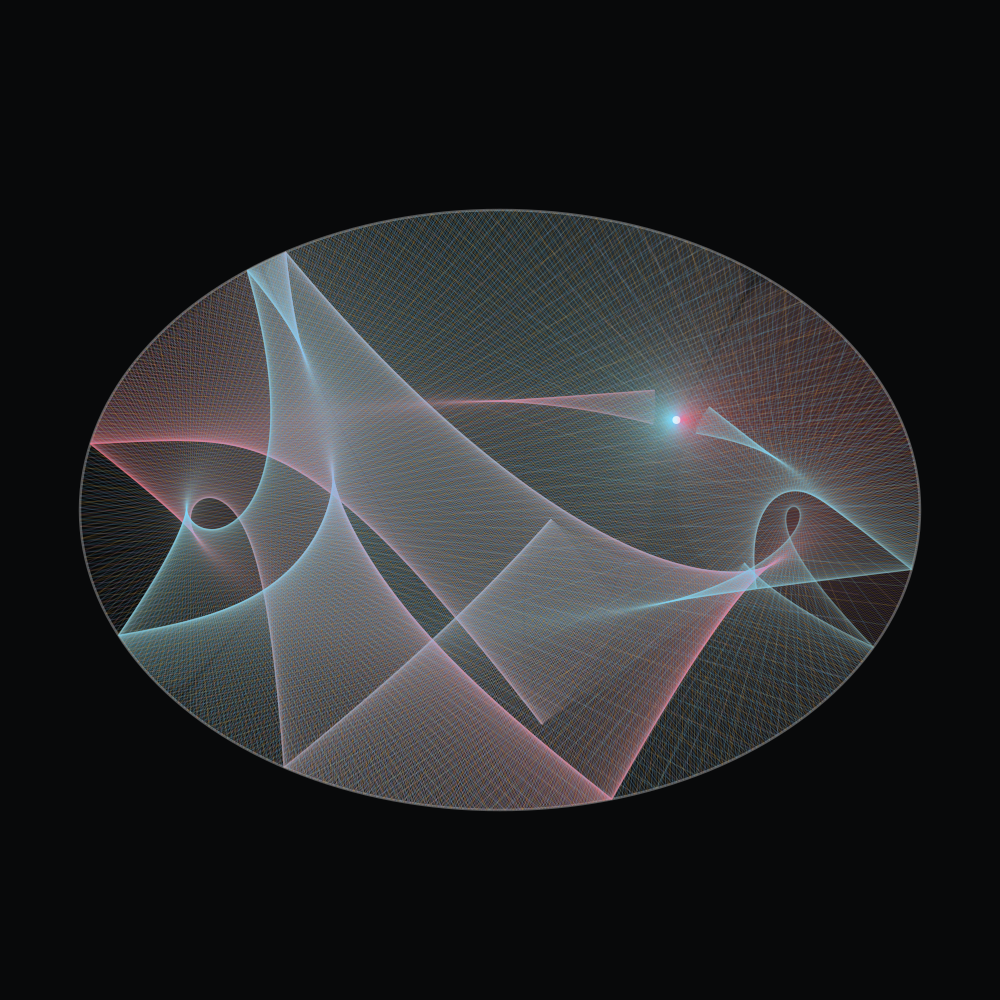
Rays bounce inside a heart-shaped mirror. Every bright line is a caustic.
angle in = angle out5,000 rays of light leave one point inside a heart-shaped mirror. The heart is the same curve as in No. 002. Each ray bounces off the wall with angle in = angle out.
Caustics
After a few bounces, the rays stop looking like rays. Bright curves appear where many neighbouring rays run almost side by side. These are caustics, the same thing as the bright line on the surface of a cup of coffee or the shifting light on the bottom of a swimming pool.
Why the heart is different from the ellipse
In the ellipse (No. 005), every ray keeps touching one smooth curve forever, so the caustics stay neat and steady. The heart has a sharp point and a dip, and rays that hit near them are thrown in very different directions. Some caustics stay sharp; others break up into a fine tangle.
The mirror is modelled as a 4,000-sided polygon that follows the heart curve, and every reflection is computed exactly. At the end the rays slow down and the heart beats twice.